
What Momentum Actually Is — and Why It Keeps Working
The clues institutions leave behind that could lead to the next big winner; and the difference between a leader and a lottery ticket. Momentum Investing 101 · Lesson 2

“Buy strong stocks.”
At first glance, it sounds like terrible advice.
Why would you buy something that’s already gone up? Wouldn’t the smart move be to buy what’s cheap and beaten down with a low PE?
That’s what most people instinctively believe. I believed it too.
Then I read How to Make Money in Stocks by Bill O’Neil, and I couldn’t believe what I was seeing: everything I had ever learned about stocks, proven mathematically incorrect. The biggest winners in history almost never begin their biggest advances from 52-week lows. They begin them near 52-week highs.
I became fascinated, and I kept studying it until I went all in.
The evidence
Momentum — the tendency for stocks that have outperformed over the past 3–12 months to continue outperforming — is one of the most thoroughly researched phenomena in finance. It has persisted across decades, countries, and asset classes. Researchers who spent their careers believing markets were perfectly efficient eventually described momentum as the “premier anomaly.”
In plain English: it shouldn’t work, but it stubbornly does.
You don’t need academic papers to see it.
Pull up the biggest winners of the past twenty years — NVIDIA, Apple, Tesla, Amazon, Monster Beverage, Netflix. Every one of them spent much of its biggest advance near 52-week highs, looking expensive almost the entire way.
More recently, same story. NVDA, SNDK, BE, PLTR — all reached all-time highs before going on record runs.
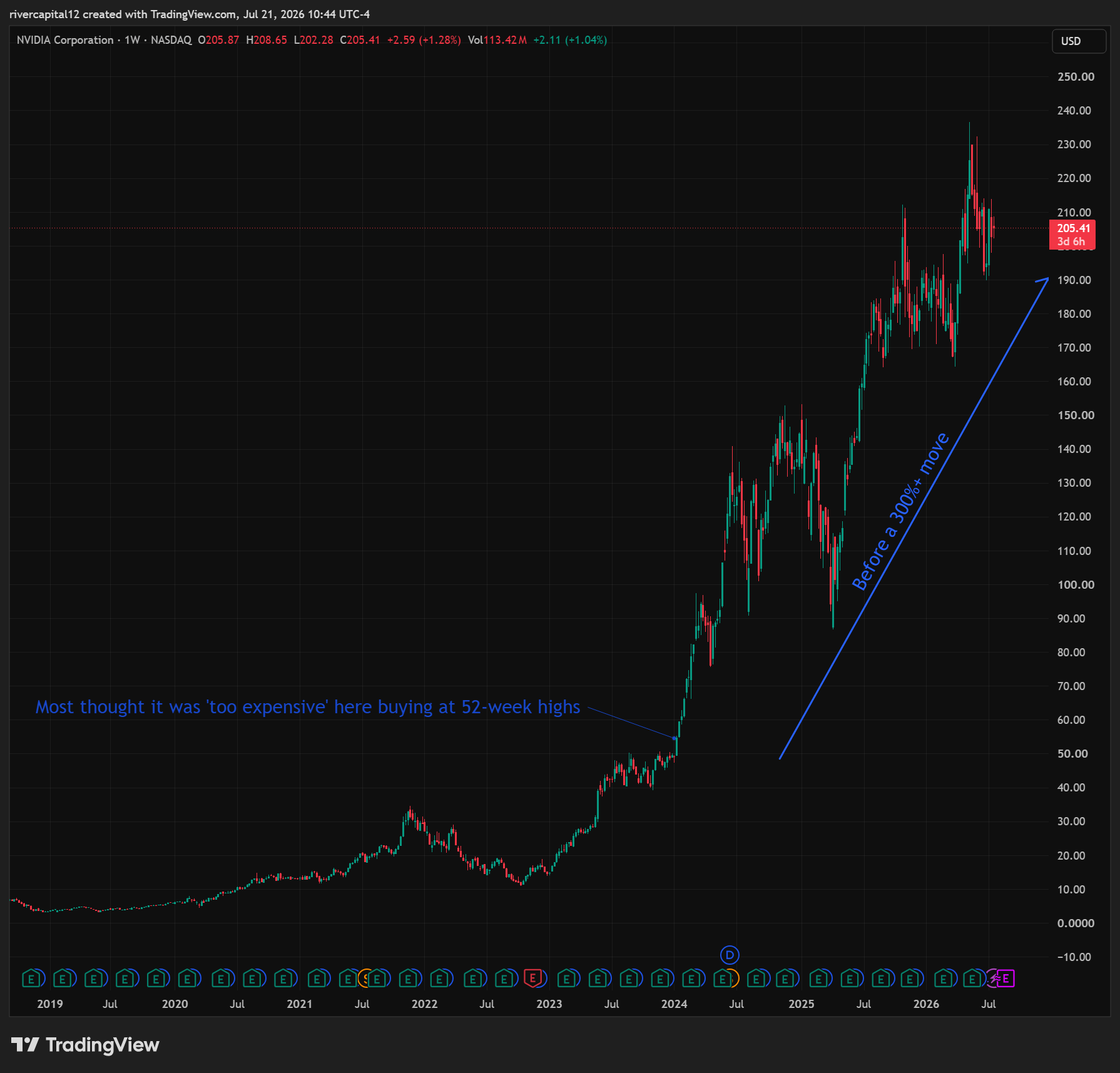
Take NVDA. Most investors thought it was too expensive buying at the 52-week high, before it went on to rally over 300%:
Why it works
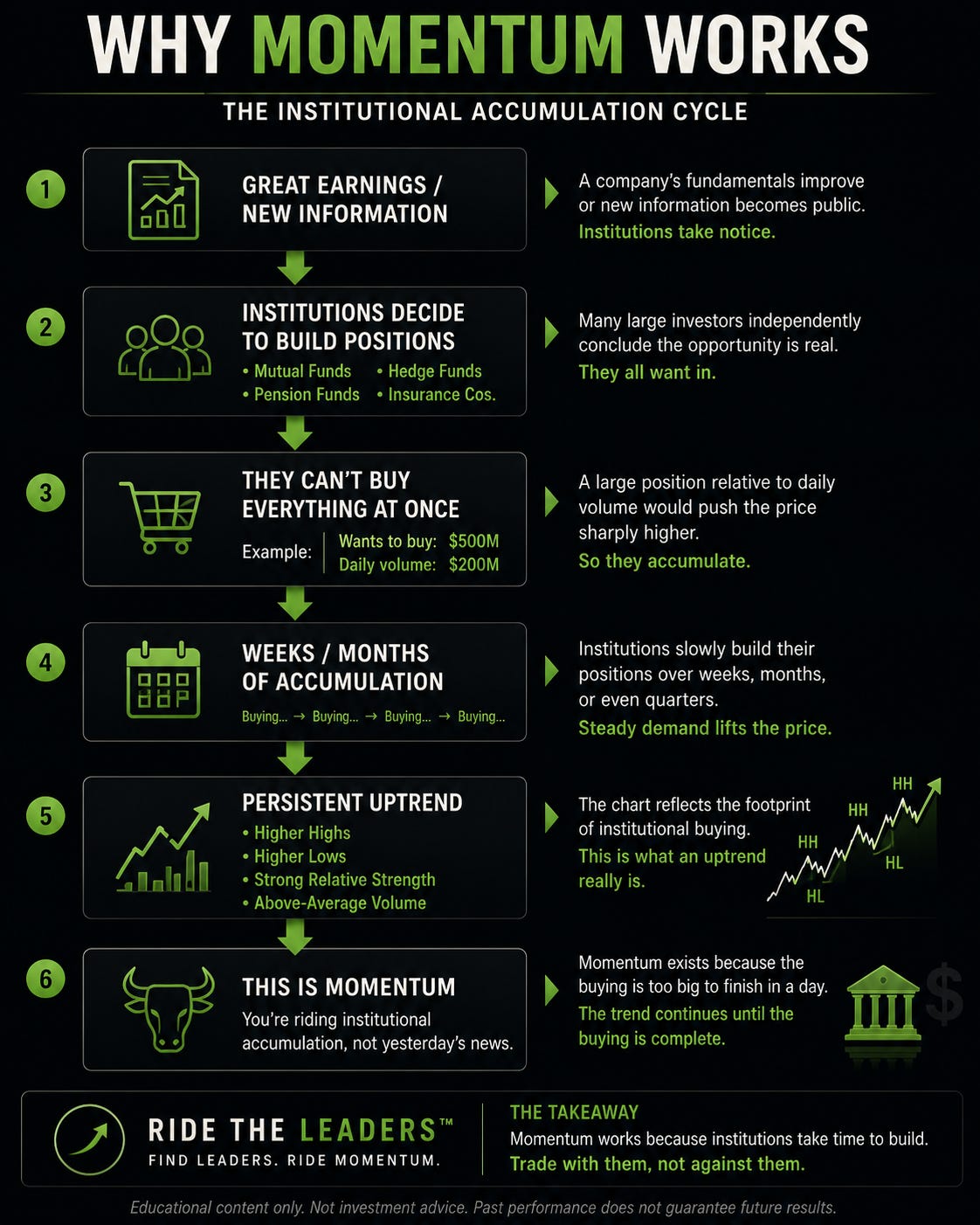
A stock doesn’t go from $50 to $300 because you or I bought a few shares. It takes billions of dollars. And billions of dollars mean institutions — mutual funds, pension funds, hedge funds, insurance companies.
Here’s the key. When a large institution wants to start a position in a stock, it can’t buy it all in one day. Imagine a fund that wants a $500 million position in a stock that only trades $200 million worth of shares each day. If they tried to buy everything immediately, they’d push the price sharply higher before they finished.
So they hide their purchases — spreading the buying over days and weeks to get a better price before the idea gets out to retail.
And it’s rarely just one institution. When a company’s fundamentals improve, dozens of large investors independently reach the same conclusion, each building a position over weeks or months, each supporting the stock on every pullback.
That slow, persistent accumulation is what an uptrend really is.
It’s also why people underestimate how important it is to study volume. Volume is one of the few signs a retail trader has that an institution is buying. When you see a stock making higher highs and higher lows for months on above-average volume, you’re looking at the footprint of buying that’s too big to finish in a single day.
That’s why momentum works. You’re riding a wave that can’t complete quickly.
Why great news keeps working
A company reports incredible earnings. The stock gaps up 12%. Most people assume the opportunity is over.
Often, it’s just beginning. The headline is known in a minute — but the institutions that suddenly want meaningful positions still need weeks or months to build them. Momentum isn’t driven by the news. It’s driven by the buying that follows it.
What momentum is not
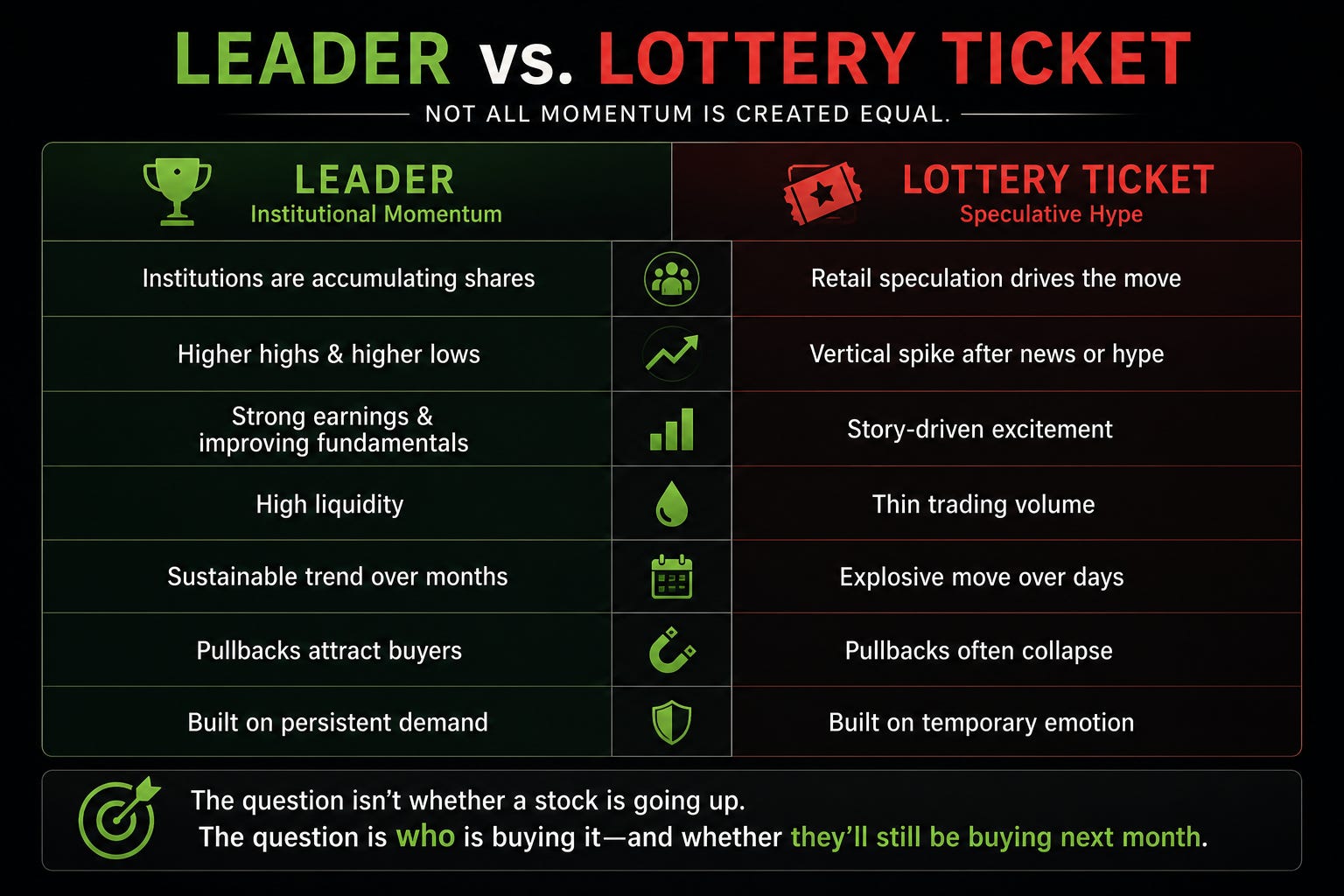
Momentum doesn’t mean buying anything that’s going up. A stock that jumps 40% in three days on a short squeeze isn’t showing institutional accumulation — nobody is building a position, and there’s no floor under it.
Real momentum means sustained relative strength over months, in liquid names big money can actually own, with the volume signature of accumulation behind it. That’s the difference between a leader and a lottery ticket.
One important caveat
Even the strongest stocks struggle when the overall market breaks down. Momentum tells you what to buy. It does not tell you whether you should be buying at all. That’s the job of market regime — we’ll cover it in Lesson 5.
The takeaway
Fish where the institutions are feeding.
Don’t spend your time searching for broken companies that might recover someday. Look for the businesses institutions are actively accumulating today. That’s where the biggest winners have always been — and it’s where I spend my time looking every week.
Try this yourself
Pick ten of the biggest stock market winners from the last decade. Open a weekly chart and find the beginning of the largest advance. Then ask one question: was the stock closer to its 52-week high, or its 52-week low?
You’ll get the same answer again and again.
Educational content only. Nothing in Ride The Leaders™ constitutes investment advice or a recommendation to buy or sell any security.